
The Marketing Mistakes Holding Trades Businesses Back
Most trades businesses don’t struggle because of poor workmanship. In many cases, the quality of work is strong, customers are broadly satisfied, and referrals keep the diary reasonably full.
The problem usually sits elsewhere.
As trades businesses grow, marketing decisions are often made under pressure rather than with intent. Activity ramps up when enquiries dip, slows down when things feel busy again, and never quite settles into something deliberate or repeatable. Over time, this creates frustration and the sense that marketing never really delivers what it promises.
The issue isn’t effort or ambition. It’s a series of common mistakes that quietly limit progress.
Marketing driven by urgency rather than intent
A lot of trades marketing exists in reaction mode.
Ads are switched on when the phone goes quiet. Social media gets attention when someone remembers to post. Websites exist, but often don’t reflect how the business actually wants to operate. There’s rarely a clear connection between marketing activity and the type of work the business wants more of.

Emergency jobs, planned installations, servicing contracts and commercial work all behave very differently. They attract different customers, at different times, with different expectations. When marketing doesn’t reflect those differences, spend gets diluted and enquiries feel unfocused.
The result is a business that stays busy, but never quite feels in control of demand.
Trying to appeal to everyone and filtering no one
Many trades businesses still market themselves in the broadest possible terms, hoping to capture as many enquiries as they can.
On the surface, that feels sensible. In practice, it attracts the very enquiries that cause the most frustration. Price shoppers, boundary-pushers and people with unrealistic expectations tend to respond best to vague messaging.
Clear marketing filters. It sets expectations before contact is made and gives customers a sense of how the business works. When that clarity is missing, those conversations happen later, often when time has already been wasted.
This is how businesses end up busy without feeling profitable or stable.
Letting frustration leak into public view
Social media has become an outlet for frustration in the trades.
Posts about nightmare customers, unpaid invoices or bad reviews might feel justified in the moment, especially when pressure is high. The problem is that potential customers are watching quietly.
Homeowners want reassurance. Commercial clients want predictability. Property managers want confidence that issues will be handled calmly. When frustration becomes visible, trust drops, even if the quality of work itself remains high.
Marketing shapes perception as much as promotion. Once confidence is damaged, it’s hard to rebuild.
Outgrowing the way the business communicates
What works when a business is small doesn’t always scale.
As soon as there are multiple engineers, office staff and larger contracts involved, customers expect consistency. Clear messaging. Clear processes. Clear responsibility.
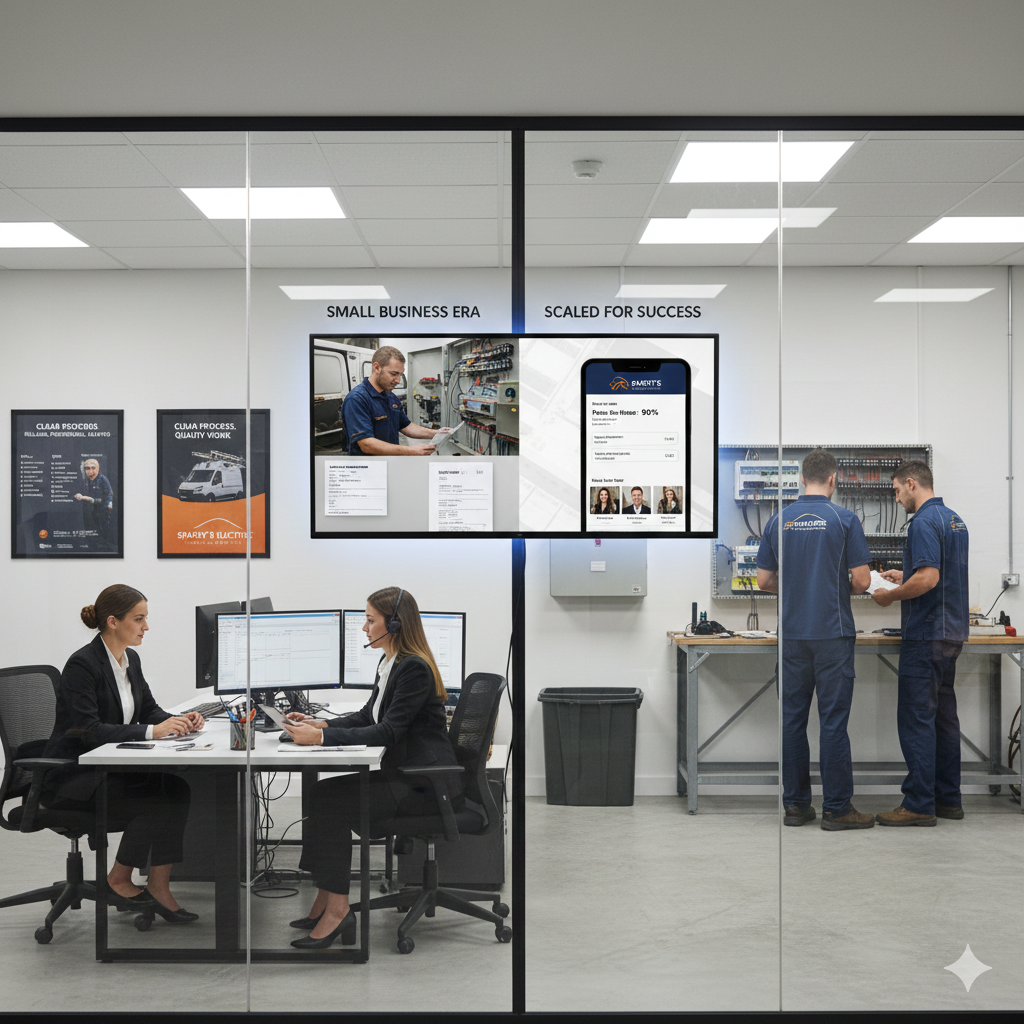
Many trades businesses grow operationally but continue to communicate as if they’re still a one-person operation. That mismatch creates uncertainty. Nothing may be wrong behind the scenes, but the presentation doesn’t match the ambition of the business.
Professional communication doesn’t mean losing personality. It means being deliberate about how that personality shows up.
Using marketing to compensate for deeper problems
It’s common to see marketing used as a fix for issues elsewhere in the business.
More leads are sought when follow-up is slow. Advertising increases when internal systems are stretched. Social media activity ramps up when enquiries dip, even though the underlying experience hasn’t changed.
Marketing amplifies whatever already exists. If systems, communication or expectations aren’t clear, more visibility simply brings those issues to the surface more often.
This is where growth starts to feel chaotic rather than controlled.
Mistaking activity for progress
There’s a growing belief among trades businesses that they should be doing more marketing because others appear busy online.
Posting frequently, trying new platforms or copying competitors creates a sense of movement, but not necessarily results. Being visible without purpose rarely builds momentum.
Relevance matters more than volume. Showing up consistently where demand actually exists has far more impact than spreading effort thinly across every platform.
The strongest trades businesses are selective. They focus on what supports their goals and ignore the rest.
What good looks like in practice
Good marketing for trades businesses tends to be quieter than people expect.
It starts with clarity around the type of work the business actually wants more of, rather than chasing every possible enquiry. Messaging reflects that focus, setting expectations early and filtering out poor-fit jobs before time is wasted.
Paid activity is built around real demand, not guesswork. Targeting is tight, budgets are controlled, and performance is reviewed with a view to improving lead quality rather than just increasing volume. Marketing runs consistently in the background instead of being switched on and off in moments of panic.
Communication feels considered and professional without losing personality. Social channels support trust rather than undermining it, and frustration stays off the public stage. As the business grows, the way it presents itself grows with it.
Most importantly, marketing supports how the business wants to operate day to day. It brings in the right work, at the right pace, and gives the business room to grow without creating unnecessary pressure.
That’s when marketing stops feeling like a gamble and starts doing its job properly.
