
5 Meta Ads Mistakes That Are Costing Your Business Money
“We’ve tried Facebook Ads before and they didn’t work.” is a phrase that comes up regularly when speaking to prospective clients.
Sometimes it’s true. There are plenty of poorly managed campaigns burning through budget every day, and Meta certainly isn’t immune from bad strategy, weak creative or unrealistic expectations. More often, though, the explanation is far less straightforward than simply declaring that Facebook Ads don’t work.

Over the years, we’ve reviewed accounts across eCommerce, automotive, renewables, professional services and membership organisations. The industries may be very different, but many of the same patterns appear repeatedly. Businesses invest heavily in advertising platforms, focus intensely on audiences and budgets, and spend surprisingly little time examining the foundations that ultimately determine whether a campaign succeeds or fails.
One of the reasons Meta can be frustrating is that it often exposes weaknesses elsewhere in the customer journey. A campaign can generate highly relevant traffic, but if the website creates confusion, the enquiry process feels cumbersome or the creative fails to build confidence, the platform ends up taking the blame for problems it didn’t create. That’s why the most successful Meta campaigns rarely come from obsessing over individual settings inside Ads Manager. They come from understanding how the entire journey fits together, from the first impression through to the final conversion.
The five mistakes below are some of the most common issues we uncover when reviewing accounts that should be performing far better than they are.
Assuming Meta’s automation can compensate for weak foundations
Meta has invested heavily in automation over the last few years, and there is no question that the platform has become significantly more sophisticated as a result. Advantage+ campaigns, automated bidding, dynamic creative and machine learning have removed much of the manual work that advertisers once spent hours managing. In many situations, Meta is capable of making optimisation decisions faster and more effectively than a human ever could.
The mistake is assuming that automation has somehow removed the need for strategy. Businesses often treat AI-driven features as a shortcut to performance, expecting the platform to solve problems that exist elsewhere in the marketing process. The reality is that Meta can only optimise using the information and signals it receives. If tracking is inaccurate, the website struggles to convert visitors or the creative fails to attract attention, the platform has very little meaningful information to work with.
This becomes particularly obvious when reviewing established accounts. The campaign structure may look perfectly reasonable, the targeting may be broadly correct and the budgets may be sensible. The issue often sits deeper than that. We’ve seen businesses optimise towards website activity that had little commercial value because the reporting looked positive. We’ve seen accounts generating large volumes of traffic while very few visitors were taking meaningful action. We’ve also seen businesses embrace every automation feature available while relying on weak landing pages and poor conversion tracking underneath.
In each case, Meta continued doing exactly what it was designed to do: optimise around the signals it received. Automation is incredibly powerful when it’s built on strong foundations. Without those foundations, it often accelerates existing weaknesses rather than solving them.
Treating every prospect as though they’re ready to buy
Many businesses advertise as though every person seeing their advert has already completed the research stage of the buying journey. The advert asks for an enquiry, a consultation, a purchase or some other form of commitment despite the fact that the audience may have had no previous interaction with the brand.
That approach rarely reflects how buying decisions are actually made. A person buying a low-cost impulse product behaves very differently to somebody researching solar panels, considering a new flooring project, selling a performance vehicle or joining a membership organisation. The level of commitment, reassurance and research required varies enormously, yet many Meta campaigns present the same message to everybody regardless of where they are in the decision-making process.
This is where audience segmentation and sequential retargeting matter. Someone discovering your business for the first time often needs a different conversation to somebody who has visited your website multiple times, engaged with content or explored specific products. A first-time visitor may need to understand who you are and why you are credible, while a returning visitor may need reassurance, proof, product reminders or a clearer reason to enquire.
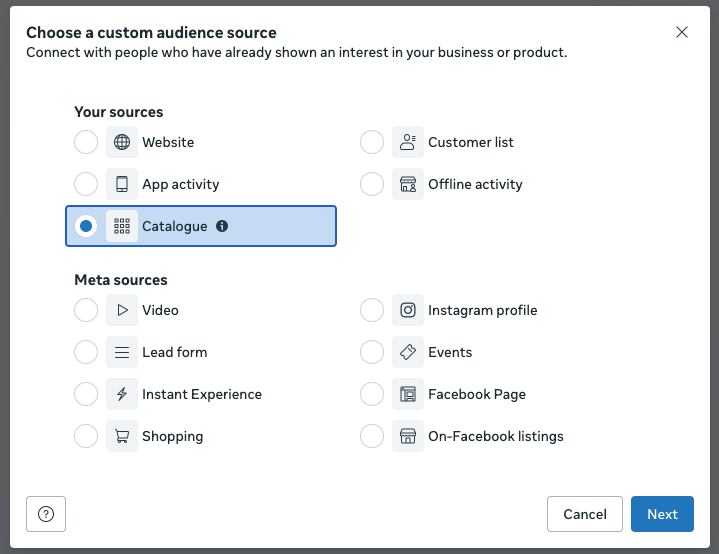
We’ve seen businesses spend thousands of pounds attracting new audiences while doing very little with people who have already visited key pages, viewed products or engaged with previous campaigns. Those audiences are often much closer to making a decision, yet they frequently receive exactly the same advertising as someone encountering the business for the very first time.
This is particularly important for eCommerce businesses with larger catalogues. Someone who has viewed a product, added a sample to their basket or browsed a specific category is showing a different level of intent to someone who has only engaged with a broad awareness ad. Dynamic product ads and retargeting campaigns can be incredibly effective because they allow the advertising to reflect what someone has already shown interest in, rather than pushing the same generic message to everyone.
Meta has become exceptionally good at finding relevant audiences, but identifying the right people is only part of the challenge. The messaging still needs to reflect where those individuals are in the buying journey and what information they need before they’re ready to take the next step.
Confusing optimisation with testing
This is one of the least understood areas of Meta advertising, and it regularly leads businesses to draw the wrong conclusions from their own campaigns.
Meta’s objective is to achieve the best possible outcome using the information available. If one advert starts generating stronger early signals than another, the platform will usually allocate more budget towards it. That behaviour makes sense from an optimisation perspective because Meta is pursuing efficiency, but it can become a problem when a business is trying to understand what genuinely works.
Businesses often assume they have tested five different adverts because five adverts were added to a campaign. In reality, one creative may have received the overwhelming majority of the budget while the others gathered very little data. Those adverts may not have failed. They may simply never have been given enough exposure to produce a meaningful result.
This is sometimes described as a winner-takes-all loop. One advert receives more spend, gathers more data and strengthens its position further, while other variations are pushed further into the background. Left unchecked, this can lead businesses to keep investing in one early winner without ever properly understanding whether other messages, formats or creative angles could have performed better.

We’ve encountered accounts where businesses believed they had thoroughly tested audiences, creative concepts and offers when the platform had effectively made the decision for them within the first few days. As a result, potentially valuable insights were never uncovered because the testing process wasn’t structured in a way that allowed them to emerge.
Campaign Budget Optimisation can be extremely useful once a campaign is established and the primary objective is efficiency. During creative or audience testing, however, it can make performance harder to interpret because Meta is focused on finding the quickest route to the result, not giving every variation an equal opportunity. In some situations, separating tests into individual ad sets with guaranteed budgets gives a much clearer picture of what is actually working.
The distinction matters because optimisation and testing are not the same thing. One is about improving performance using existing information. The other is about generating new information that helps future decisions become more effective.
Letting creative go stale
Creative is still one of the most important variables in Meta advertising, even with all the advances in automation, targeting and machine learning. The advert itself remains the first thing someone sees, and audiences become familiar with creative far more quickly than many businesses realise.
We’ve reviewed accounts where the same adverts have been running for six months, nine months or even longer. Performance gradually declines, costs increase and engagement falls away. The immediate reaction is often to look at audiences, budgets or bidding strategies, when the most obvious issue is sitting directly in front of the customer.
In many cases, performance starts declining because audiences have become extremely familiar with the creative. What initially felt fresh and engaging gradually becomes part of the background noise of the feed, particularly when the same images, videos or messaging have been running for months without meaningful variation.

This has become even more noticeable as social feeds fill with increasingly similar content. Generic stock imagery, templated graphics and AI-generated visuals appear across almost every industry. Businesses spend time trying to make adverts look polished, yet end up publishing creative that feels very similar to everything else competing for attention.
Some of the strongest-performing campaigns we’ve seen use straightforward content that reflects the reality of the business. Product demonstrations, customer stories, behind-the-scenes footage, team members sharing expertise and short-form videos filmed on a phone can all work extremely well when they are relevant and well timed. In many cases, these outperform more polished alternatives because they feel authentic and provide genuine value to the audience.
Blaming Meta for problems after the click
One of the most common scenarios we encounter is a campaign generating relevant traffic that fails to convert once visitors reach the website. The immediate assumption is usually that the advertising isn’t working, but a closer inspection often reveals problems elsewhere. The messaging may be unclear, the landing page may create confusion, the enquiry process may feel cumbersome, or the website may simply fail to build enough confidence for somebody to take the next step.
This is where paid social performance needs to be viewed as part of a wider customer journey. Meta can generate awareness, attract attention and bring people onto the website, but it cannot force a weak landing page to convert. If the site doesn’t make it obvious what the business does, visitors hesitate. If an eCommerce category contains hundreds of products with limited guidance, customers become overwhelmed. If the website is a one-page site with little depth, there may not be enough information to build trust.
We’ve seen businesses spend months refining campaigns while ignoring the fact that their enquiry forms ask for excessive information, their websites load slowly or their key landing pages fail to answer the questions customers are actually asking. In those situations, improving campaign performance often starts with fixing the experience after the click rather than making further changes inside Ads Manager.
This is why audits often need to go beyond the advertising account itself. Looking only at audiences, budgets and settings can miss the most important part of the problem. The campaign may be doing its job by getting the right people to the right place, while the website or sales process is quietly reducing the chance of conversion.
The bigger picture
Businesses often go searching for answers inside Ads Manager because that’s where the spend happens and it’s the most obvious place to start looking when performance falls short. The challenge is that advertising platforms tend to expose existing weaknesses elsewhere in the marketing process. Poor creative, weak messaging, confusing websites, ineffective follow-up and inaccurate tracking can all influence results long before campaign settings become the primary issue.
The strongest Meta campaigns are usually supported by good creative, accurate tracking, sensible campaign structures, effective retargeting and websites that help people move confidently towards a decision. Remove one of those elements and performance begins to suffer. Remove several, and even a well-managed campaign will struggle to produce the return it should.
Businesses often assume Meta Ads are underperforming because that’s where the budget is being spent. In reality, advertising platforms are remarkably good at exposing weaknesses elsewhere in the customer journey. Running more ads, increasing budgets or launching new campaigns rarely solves those underlying issues on its own.
The businesses that consistently generate strong returns from Meta understand how advertising fits into a wider marketing and sales process. They invest just as much effort into the customer journey after the click as they do into the campaign itself because they recognise that conversions are influenced by every stage of the experience, not just the advert that generated the visit.
If you’re investing in Meta Ads and questioning whether they’re working, the answer may not be found inside Ads Manager. It may be found in the creative, the website, the tracking setup or the wider customer journey.
At Agilita Digital, we help businesses understand what’s really affecting performance. Whether the issue sits in the campaigns themselves or somewhere further along the conversion journey, identifying the real cause is always the first step towards improving results. If you’re looking to get more out of your Paid Social campaigns, then get in touch with us today.
