
One-page websites limit how a business can be found, understood and developed online.
They tend to be chosen because they are quick to build and easy to manage. Everything sits in one place, which creates a sense of simplicity. That approach starts to break down once the website is expected to do more than present a basic overview. Search visibility, user understanding and long-term growth all depend on structure, and a single page restricts that structure from the outset.
How search engines and users interpret a site
Search engines work at the page level.
Each page carries its own set of signals through its title, headings, content and internal links. When those signals are focused on a specific topic or service, it becomes easier to understand what that page represents and where it should appear in search results. A structured site builds up coverage across different areas by allowing each page to do a clearly defined job.
A one-page site brings everything together into a single document. Services, locations and supporting content all sit within the same space, which removes any clear separation between them. As more content is added, the scope of the page expands, but the signals become less precise. It becomes harder to align specific queries with specific sections, and the site struggles to build consistent visibility beyond a narrow set of terms.
That same lack of separation affects how people use the site. Visitors tend to arrive with a specific purpose, and they expect to find information that matches it clearly. When everything is grouped together, they have to work to locate what they need, and the overall experience becomes less direct.
Depth, clarity and credibility all rely on structure
A website needs to provide enough detail for someone to understand what a business does and feel confident engaging with it.
That level of understanding comes from giving each area of the business the space it needs. Services can be explained properly, supporting information can sit alongside them, and the overall flow of the site can guide someone through a clear journey.
A single page reduces how that information is delivered. Important points are condensed into shorter sections, and supporting content competes for attention within the same layout. As more is added, the page becomes longer and harder to navigate, which makes it difficult to maintain clarity. The result is a site that feels compressed, where the detail exists but is not presented in a way that is easy to absorb.
That has a direct effect on how credible the business feels.
Measurement, performance and growth become constrained
Improving a website depends on understanding how it is used.
With a structured site, each page provides its own set of data. It becomes possible to see which services attract attention, how users move through the site and where engagement is strongest. That information supports better decisions and more targeted improvements.
A one-page site limits that visibility. Everything sits within the same page, which makes it difficult to isolate performance. Scroll depth and time on page offer some indication of behaviour, but they do not show how individual sections contribute to engagement or conversions. That reduces the ability to refine the site based on real usage.
Performance is affected as content increases. Images, video and scripts all load together, which increases page weight and load time. This creates friction, particularly on mobile devices, and affects how long users stay on the site. Search engines also factor performance into their assessment, which means slower pages can struggle to perform as well as they could.
Growth becomes difficult at the same time. As new services or content are introduced, the page extends further, navigation becomes less efficient and the structure becomes harder to manage. The site reaches a point where it no longer supports the business in a practical way.
A real example: Julian McBride
This is something we worked through recently with Julian McBride, and it’s a good example of how these decisions tend to happen in practice.
His original website had been built as a single page after being advised that it was the right approach. The logic behind it sounded reasonable enough. Keep everything in one place, make it easy to manage, avoid unnecessary complexity. The business recommending it positioned themselves as experienced in this space, which made that advice feel credible. Their own website followed the same approach, which should have prompted a bit more scrutiny.
The end result looked tidy, but it left very little room for anything to be developed properly.
Julian’s racing, driver coaching and commercial work all sat within the same page. Each area was reduced to a summary, with no real space to explain what was involved or who it was aimed at. From a search perspective, everything was grouped together under a broad theme, which meant there was very little context for specific queries to connect with. From a user perspective, there wasn’t much to engage with beyond a surface-level overview.
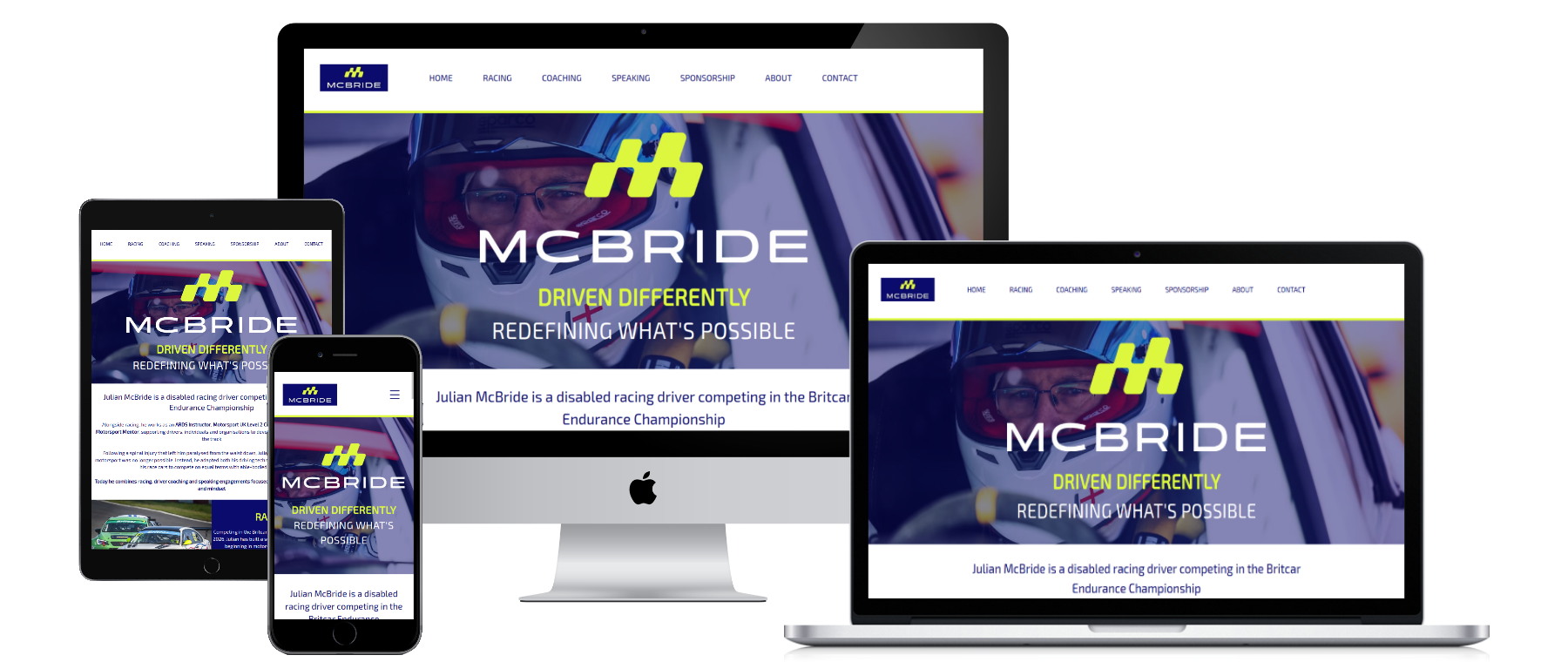
That became more of an issue when you consider what he actually wanted the site to do. He was keen to be found for specific areas of his work, including motorsport coaching, speaking, and topics around disabled racing drivers. Those are not generic searches. They carry clear intent, and they rely on content that speaks directly to them. There is also an increasing number of people using AI tools to explore those topics in more detail, asking full questions and expecting structured, relevant answers in return.
Trying to cover all of that within a single page leaves very little room to do any of it properly. There is no clear separation between topics, no depth behind individual areas, and no structure for search engines or AI-driven systems to interpret in a meaningful way.
The rebuild focused on introducing structure and giving each part of his work its own space. Racing, coaching and commercial activity were separated into dedicated pages, with content that reflects what each area actually involves. Navigation became clearer, the messaging tightened up, and the site began to represent the full scope of what he does.
That change has a practical impact. Search engines have clearer signals to work with, the site can appear for a wider range of relevant queries, and visitors have something they can actually engage with. It also creates a foundation for future content, so the site can continue to develop without running into the same limitations again.
Where a single page can still make sense
There are situations where a one-page approach is sufficient.
Very small businesses with a narrow offer can operate within that structure. Portfolio sites can use a single page effectively, and product-focused landing pages can work when they are built around a single action. In these cases, the scope remains limited, and the expectations placed on the site are lower.
A more useful way to approach it
Consider what the website needs to communicate and how people are likely to search for it.
Each service, each audience and each type of enquiry usually requires its own space. That allows for clearer messaging, better alignment with search behaviour and a more structured experience for visitors.
From there, the site can be developed in a way that supports both users and search engines, while leaving room for future growth.
If your website feels limited, difficult to expand or isn’t attracting the right type of traffic, the issue often sits in how it is structured. Giving the site the space it needs allows it to perform more effectively over time.
