
Why £99-a-Month Websites Are a False Economy
If you spend any time on Facebook, Instagram or even LinkedIn, you’ll have seen the ads. Websites for £99 a month. Hosting included. Support included. No upfront cost. Nothing to think about.
On the surface, it sounds sensible. The cost is predictable, the commitment feels small, and someone else takes care of the technical side. For busy business owners, especially in the trades, that pitch lands easily.
The issue is that these ‘deals’ aren’t built around helping a business grow. They’re built around getting people signed up and keeping them there, often for far longer than expected, regardless of whether the website ever delivers meaningful value.
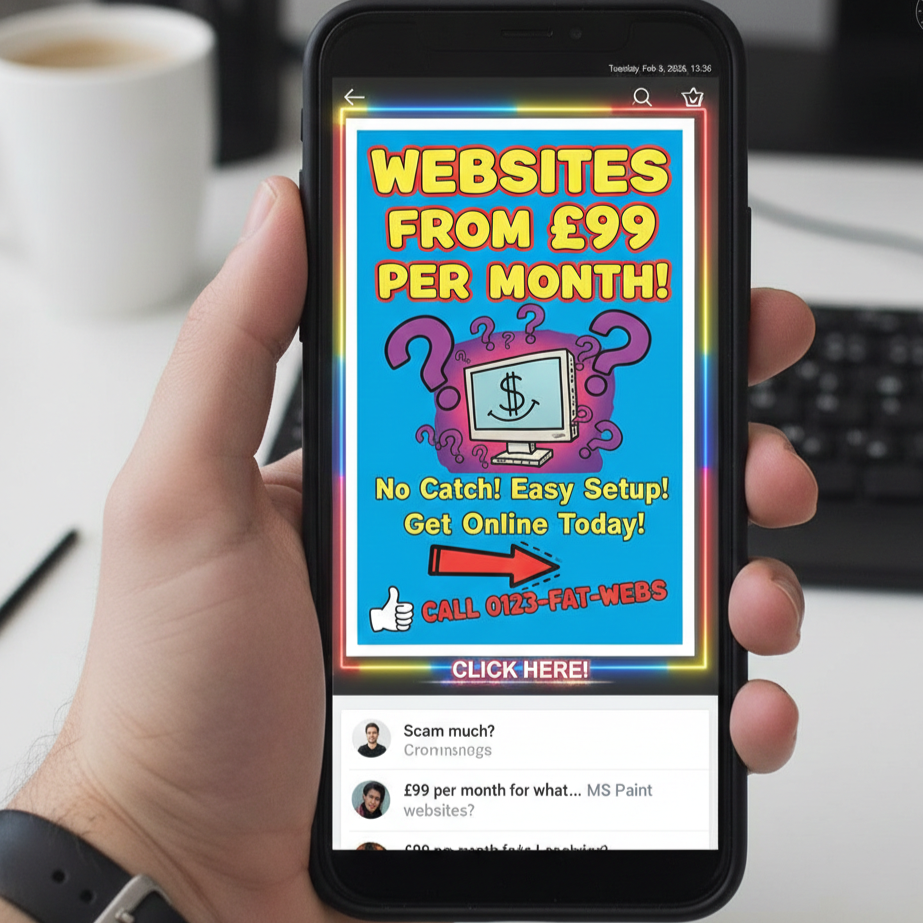
Who these so-called ‘deals’ are really aimed at
Low-cost monthly website packages are overwhelmingly targeted at small service businesses, particularly tradespeople running one-person operations or small teams. Time is limited, digital experience isn’t always a priority, and the website often feels secondary to getting work booked in.
That makes the promise of a cheap, hands-off website appealing. Someone else builds it, hosts it and “looks after it”, while the business focuses on jobs and customers. The monthly cost feels manageable and the decision doesn’t feel permanent.
You typically don’t see the same model aimed at eCommerce or automotive businesses. Those sectors understand that their website directly affects revenue, lead quality and profitability. A £99-a-month website wouldn’t support stock management, integrations, conversion optimisation or ongoing refinement. Trades websites look simpler on the surface, which is why they’re treated as disposable, even though for many businesses they’re the primary source of new enquiries.
The business model behind cheap websites
Websites at this price point are built for volume rather than outcomes.
Templates are reused repeatedly. Content is generic and interchangeable. Decisions are driven by speed and scale, not by an understanding of how a business actually wins work. There’s no room for strategy, proper SEO planning or conversion thinking because the margins don’t allow for it.
What often goes unmentioned is the contract. These packages are rarely month to month. 12 or 18-month minimum terms are common, sometimes longer. The low monthly cost disguises a long commitment that becomes difficult to exit once the site is live.
By the time a business realises the website isn’t helping, they’re already locked in.
Why “it looks fine” isn’t enough
Most of these websites look acceptable at first glance. That’s intentional.
Clean templates and modern fonts create the impression of quality, but very little thought has gone into how the site functions as part of the wider business. Pages exist because they’re part of a package, not because they answer real customer questions. Calls to action are generic. Content fills space rather than building trust or guiding decisions.
A website that simply exists isn’t doing its job. If it isn’t helping generate enquiries, improve lead quality or make it easier for customers to choose you, it’s failing to earn its keep.
SEO is promised, but rarely designed in
SEO almost always features somewhere in the sales pitch. It’s rarely built into the foundations.
Search performance relies on structure, intent, content depth, internal linking and technical decisions made early on. Cheap website builds reuse the same layouts, headings and content patterns across dozens or hundreds of sites.
Local intent is weak. Metadata is generic. Internal linking is minimal. There’s little thought given to how pages should rank or convert. When rankings don’t improve, the conclusion is often that SEO doesn’t work, rather than acknowledging that the site was never designed to compete properly in the first place.
The control and ownership problem
One of the biggest issues tends to surface later.
Simple changes often come with extra charges. Adding pages, updating content or introducing new functionality requires requests, approvals and additional fees. In some cases, businesses don’t even have full access to their own website.
Many of these arrangements mean the business doesn’t actually own the site. They’re effectively renting it. End the agreement and the website disappears, along with any search visibility or momentum built over time.
For a business that relies on inbound enquiries, that’s a significant risk to take on for the sake of a low monthly fee.
Why businesses stay longer than they should
Once a website exists, even a poor one, replacing it feels daunting.
Customers can find it. It technically works. Walking away means accepting that money has been spent on something that isn’t delivering much. With long minimum terms in place, many businesses simply wait it out.
As the business grows, the website quietly becomes the bottleneck. Ads struggle to convert. SEO stalls. Content ideas get shelved because the platform can’t support them properly. By the time the site is replaced, the total cost paid often exceeds what a properly built website would have cost in the first place.
What a healthier approach looks like
A good website doesn’t need to be extravagant, but it does need to be intentional.
That means understanding how the business wins work, what customers care about, and how the site should support that journey. It means ownership, flexibility and a structure that allows marketing activity to build over time rather than resetting every couple of years.
When a website is treated as an asset instead of a subscription, decisions improve across the board. Marketing becomes easier, SEO has something solid to work with, and updates don’t feel like negotiations. Most importantly, the site starts contributing rather than holding the business back.
